
Your change management strategy is probably broken. Despite decades of research and countless methodologies, a staggering 70% of organisational change initiatives still fail (Kotter, 1995; Bonnet, 2022; Mankins and Litre, 2024). In 2026, as businesses face unprecedented disruption from AI, ways of working, and shifting employee expectations, this failure rate isn't just disappointing: it's devastating, and costly.
Most leaders are still using outdated playbooks that treat change like a mechanical process rather than the deeply human experience it actually is. They're spending millions on consultants, workshops, and fancy software whilst completely missing the fundamental drivers that make change stick (Rowland, Thorley and Brauckmann, 2023).
The Real Reasons Your Strategy Isn't Working
Lack of compelling vision remains the number one killer of change initiatives (Kotter, 1995). When employees don't understand why they're being asked to transform, they simply won't. It's that straightforward. Yet countless organisations launch major changes with vague mission statements like "becoming more agile" or "improving efficiency." These meaningless buzzwords create confusion, not commitment.
Leadership buy-in is often superficial at best. Only 29% of change programmes succeed when leaders fail to actively champion the transformation (Mankins and Litre, 2024; Prosci, 2021). Here's what typically happens: executives announce the change, delegate implementation to middle management, then disappear back to their usual priorities. Employees notice this disconnect immediately and respond accordingly.
 Communication strategies are fundamentally flawed. Most organisations rely on one-way announcements through emails and town halls, treating communication as information dumping rather than genuine dialogue. When employees have questions or concerns, they're met with scripted responses or told to "trust the process." This approach breeds resistance, not enthusiasm (Morrison, 2023; White et al., 2023).
Training programmes miss the mark entirely. Companies spend fortunes on generic workshops that cover theoretical scenarios completely disconnected from employees' daily reality. After a half-day session on "change readiness," people return to their desks with no practical tools for steering the actual challenges they'll face (Kraiger and Ford, 2021; Garavan et al., 2021).
Cultural alignment gets ignored. Change strategies designed in boardrooms often clash spectacularly with existing company culture. Leaders assume that announcing new values or behaviours will automatically shift decades-old patterns. They underestimate how deeply embedded cultural norms really are (Schein and Schein, 2016; Groysberg et al., 2018).
The result? Employee cynicism reaches toxic levels. People start viewing change initiatives as "flavour of the month" programmes that will eventually fade away if they just wait long enough. This cynicism becomes self-fulfilling, creating a vicious cycle where future changes face even greater resistance (Zhexembayeva, 2024; Duffy and Fosslien, 2022).
5 Fixes That Actually Work
1. Create a Vision That Actually Means Something
Stop with the corporate speak. Your vision needs to answer one simple question: "What's in it for me?" Not just for the business, but for individual employees dealing with daily pressures and personal concerns (Hiatt, 2006; Kotter, 1995; Nieto-Rodriguez, 2024).
Start by identifying specific problems your change will solve. Instead of "becoming more customer-centric," explain how the change will reduce the frustrating customer complaints that keep your sales team awake at night. Rather than "improving operational efficiency," describe how new processes will eliminate the repetitive tasks that drain energy and creativity.
Make it personal and concrete. Share stories about how similar changes have improved people's work lives elsewhere. Paint a picture of what success looks like at the individual level: less overtime, clearer priorities, better tools, stronger relationships with colleagues.
Test your vision with a simple exercise: Can someone explain it back to you in their own words after hearing it once? If not, it's too complicated or abstract.
2. Get Leaders Properly Involved (Not Just Committed)
Leadership buy-in isn't about executives saying the right words at the kickoff meeting. It's about consistently demonstrating the new behaviours themselves, even when it's inconvenient or uncomfortable (Rowland, Thorley and Brauckmann, 2023).
Create visible leadership accountability. Assign specific change-related goals to each executive team member and report on progress publicly. When the CEO starts using the new project management system daily or the CFO openly discusses learning from failed experiments, employees take notice (Mankins and Litre, 2024).
 Schedule regular "leadership learning sessions" where senior managers share their struggles with adopting new approaches. This vulnerability creates psychological safety for everyone else to admit their own challenges without fear of judgment (Edmondson, 2019; Edmondson, 2023).
Embed change leadership into performance reviews. Make supporting transformation initiatives a formal part of every manager's evaluation. When career advancement depends on successfully guiding teams through change, suddenly everyone becomes much more engaged (White et al., 2023; Mankins and Litre, 2024).
3. Build Real Two-Way Communication
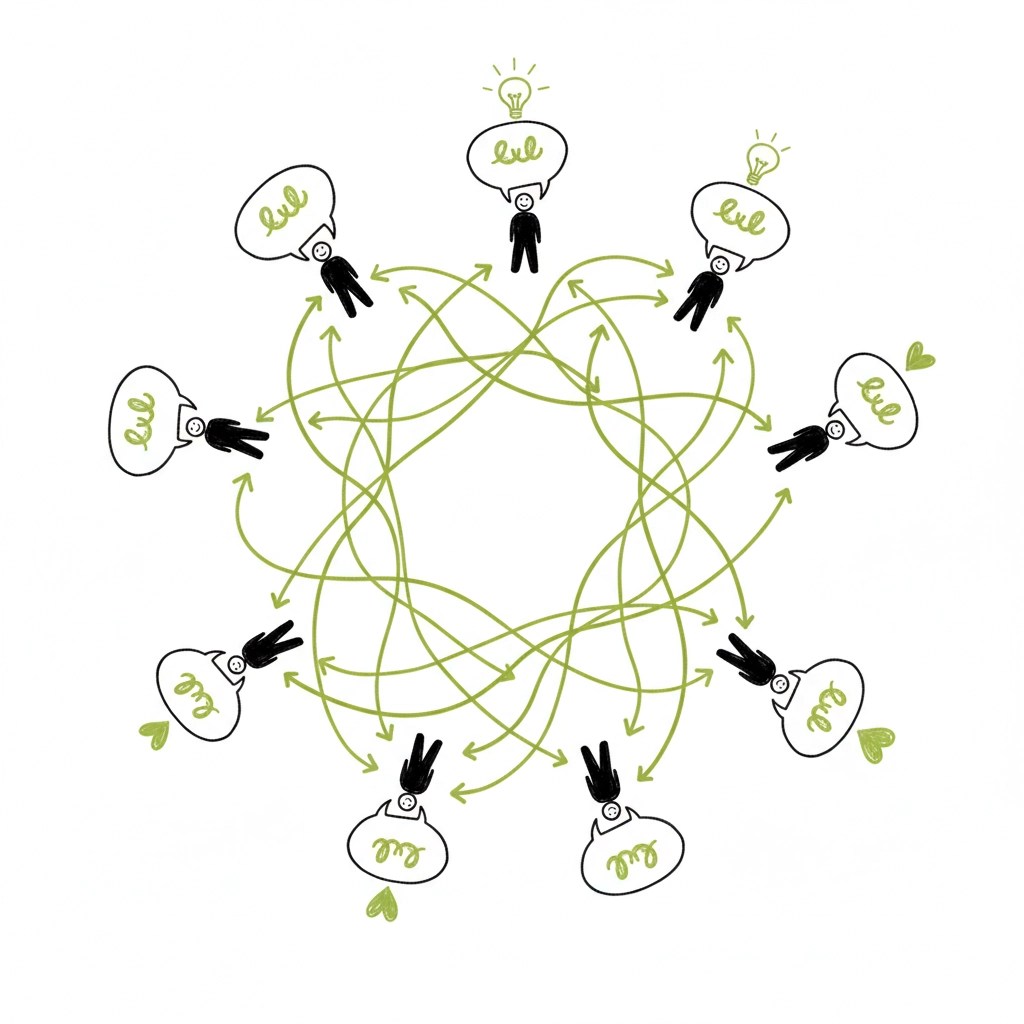
Transform your communication strategy from broadcasting to conversing. Create multiple channels for employees to ask questions, share concerns, and provide feedback: then actually respond meaningfully (Morrison, 2023; White et al., 2023).
Establish change champions throughout the organisation. These aren't just cheerleaders spouting company messaging. They're trusted colleagues who can have honest conversations about both benefits and challenges. Train them to facilitate genuine dialogue rather than deliver presentations (Rogers, 2003; White et al., 2023).
Hold regular "ask me anything" sessions where employees can raise concerns anonymously. Address the difficult questions head-on rather than deflecting or providing sanitised responses. When people see their actual concerns being discussed openly, trust increases dramatically (Morrison, 2023).
Use multiple communication formats to reach different preferences. Some people prefer detailed written updates, others respond better to visual progress dashboards, and many need face-to-face conversations to process complex changes. One size definitely doesn't fit all (Mayer, 2020; Kraiger and Ford, 2021).
4. Provide Just-in-Time Support and Training
Replace generic training sessions with ongoing, practical support that helps people navigate real situations as they arise (Kraiger and Ford, 2021; Garavan et al., 2021).
Create "change coaching" programmes where employees can get help with specific challenges they're facing (Kraiger and Ford, 2021).
Develop quick reference guides and video tutorials that address common pain points. Make these easily searchable and regularly updated based on the questions people actually ask. The goal is reducing friction, not adding more complexity (Mayer, 2020; Kraiger and Ford, 2021).
Pair people with change buddies from other departments who've already navigated similar transitions. These peer relationships often provide more valuable support than formal training programmes because the advice comes from someone who truly understands the daily reality (Bandura, 1977; Rogers, 2003).
5. Celebrate Progress, Not Just Outcomes
Most change initiatives suffer from an "all or nothing" mentality where success only counts at the final finish line. This approach kills momentum and motivation long before results appear (Kotter, 1995).
Identify and publicise early wins that demonstrate progress toward larger goals. If implementing new customer service processes, celebrate the first week where response times improved by 15%, even if the ultimate target is 50% improvement (Kotter, 1995).
Create visible progress tracking that everyone can see and understand. Simple dashboards showing movement in the right direction maintain energy and help people see how their individual efforts contribute to bigger changes.
Recognise people who embrace change rather than just those who deliver results. Highlight employees who try new approaches, ask thoughtful questions, or help colleagues adapt. This reinforces that the learning process itself has value, not just the final performance (Edmondson, 2019).
Share stories about lessons learned from things that didn't work as expected. When leaders openly discuss pivoting strategies based on employee feedback or unexpected challenges, it demonstrates that change is a collaborative process rather than a rigid mandate (Edmondson, 2023).
Change management isn't about managing change: it's about supporting people through transformation. When you focus on the human experience rather than the technical implementation, remarkable things become possible (Prosci, 2021).
These five fixes won't guarantee success overnight, but they will fundamentally shift how your organisation approaches change. Instead of fighting resistance, you'll be building genuine engagement. Rather than imposing solutions, you'll be co-creating the future with your people.
The companies that thrive in 2026 and beyond won't be those with the slickest change management processes. They'll be the ones that remember change is ultimately about people: and treat them accordingly.
References
- Bandura, A. (1977) Social Learning Theory. Englewood Cliffs, NJ: Prentice Hall.
- Bonnet, D. (2022) ‘3 Stages of a Successful Digital Transformation’, Harvard Business Review. Available at: https://hbr.org/2022/09/3-stages-of-a-successful-digital-transformation (Accessed 7 January 2026).
- Duffy, M.W. and Fosslien, L. (2022) ‘Managers, What Are You Doing About Change Exhaustion?’, Harvard Business Review. Available at: https://hbr.org/2022/05/managers-what-are-you-doing-about-change-exhaustion (Accessed 7 January 2026).
- Edmondson, A.C. (2019) The Fearless Organization: Creating Psychological Safety in the Workplace for Learning, Innovation, and Growth. Hoboken, NJ: Wiley.
- Edmondson, A.C. (2023) Right Kind of Wrong: The Science of Failing Well. New York: Atria Books.
- Garavan, T.N., McCarthy, A., Lai, Y., Murphy, K., Sheehan, M. and Carbery, R. (2021) ‘Training and organizational performance: A meta-analysis of temporal, institutional and organizational context moderators’, The International Journal of Human Resource Management. https://doi.org/10.1111/1748-8583.12284
- Groysberg, B., Lee, J., Price, J. and Cheng, J.Y.-J. (2018) ‘The Culture Factor’, Harvard Business Review, 96(1), pp. 44–52.
- Hiatt, J. (2006) ADKAR: A Model for Change in Business, Government and Our Community. Loveland, CO: Prosci Research.
- Kotter, J.P. (1995) ‘Leading Change: Why Transformation Efforts Fail’, Harvard Business Review, 73(2), pp. 59–67.
- Kraiger, K. and Ford, J.K. (2021) ‘The science of workplace instruction: Learning and development applied to work’, Annual Review of Organizational Psychology and Organizational Behavior, 8. https://doi.org/10.1146/annurev-orgpsych-012420-060109
- Mankins, M. and Litre, P. (2024) ‘A New Model for Continuous Transformation’, Harvard Business Review. Available at: https://hbr.org/2024/06/a-new-model-for-continuous-transformation (Accessed 7 January 2026).
- Mayer, R.E. (2020) Multimedia Learning. 3rd edn. Cambridge: Cambridge University Press.
- Morrison, E.W. (2023) ‘Employee voice and silence: Taking stock a decade later’, Annual Review of Organizational Psychology and Organizational Behavior, 10. https://doi.org/10.1146/annurev-orgpsych-120920-054654
- Nieto-Rodriguez, A. (2024) ‘Organize Your Change Initiative Around Purpose and Benefits’, Harvard Business Review. Available at: https://hbr.org/2024/04/organize-your-change-initiative-around-purpose-and-benefits (Accessed 7 January 2026).
- Prosci (2021) Best Practices in Change Management. 11th edn. Fort Collins, CO: Prosci.
- Rogers, E.M. (2003) Diffusion of Innovations. 5th edn. New York: Free Press.
- Rowland, D., Thorley, M. and Brauckmann, N. (2023) ‘The Most Successful Approaches to Leading Organizational Change’, Harvard Business Review. Available at: https://hbr.org/2023/04/the-most-successful-approaches-to-leading-organizational-change (Accessed 7 January 2026).
- Schein, E.H. and Schein, P.A. (2016) Organizational Culture and Leadership. 5th edn. Hoboken, NJ: Wiley.
- White, A., Wheelock, M., Canwell, A. and Smets, M. (2023) ‘6 Key Levers of a Successful Organizational Transformation’, Harvard Business Review. Available at: https://hbr.org/2023/05/6-key-levers-of-a-successful-organizational-transformation (Accessed 7 January 2026).
- Zhexembayeva, N. (2024) ‘Constant Change Is Rewriting the Psychological Contract with Employees’, Harvard Business Review. Available at: https://hbr.org/2024/06/constant-change-is-rewriting-the-psychological-contract-with-employees (Accessed 7 January 2026).
Leave a Reply